

The Unknown
Created by Ted Udall and Bernard Klein
NAME + ALIASES:
Unknown
KNOWN RELATIVES:
None
GROUP AFFILIATIONS:
None
FIRST APPEARANCE: National Comics #23 (June 1942)
APPEARANCES:
- National Comics #23-41 (June 1942–April 1944)
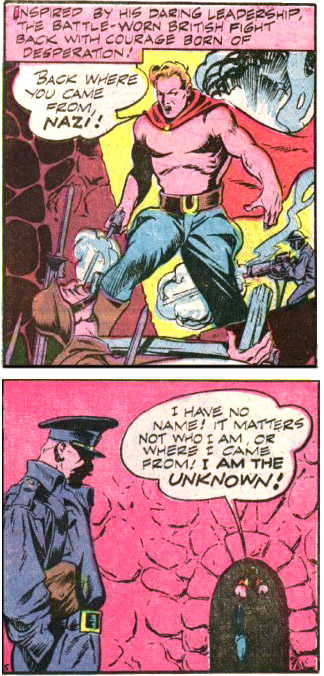
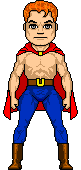
The Unknown looked very similar to another Quality hero, Hercules. Both were bare-chested and wore red capes. There was another Quality hero called “"Neon the Unknown” who was significantly different. It’s clear that the Unknown’s first several appearances were drawn by several different artists. His costume changed slightly with every issue. He began with a shirtless costume but later developed a sense of propriety and adopted a white shirt. Some artists drew a “U” on his belt.
The Unknown was an American man whose true name is lost to time. His story begins in France, June 7, 1940, after the Nazi invasion. As a civilian, he found himself allied with the French forces. Although America hadn’t entered the war, he sided with the French and survived a gunshot wound. But his injuries threw him into amnesia—he no longer remembered his own name or country. The man made his way to the historic battle of Dunkirk, where he donned a costume and fought the Nazis alongside the British and French as “the Unknown.” The Unknown refused an offer by the British military to return to England. He vowed instead to remain in Europe to fight the Nazis head-on. As he put it “I have forgotten much… but I will never forget cruelty and injustice!” (National #29)
Though he never fought a masked opponent, he once met a German commander who took a dose of cocaine for additional “courage.” The Colonel gained super-human strength from the drug. Still, he was no match for the Unknown’s innate strength. (#25)
At Vichy, the Unknown broke up a state rally aiming to prop up support for the German occupation. There he condoned mowing down the Nazis. (#26)
In Russia, he took the alias “Pete Walker” while undercover and feigned drunkenness to plant misinformation. There a German femme fatale, the spy called X-19, was working undercover among Russians. Naturally, he triumphed over her, stating, “I wish women, especially beautiful women, would keep out of this war mess.” (#28)
The Unknown was fearless within Europe, and went so far as to infiltrate the Dachau concentration camp, where he freed a train full of prisoners. (#30)
He found a shirt to wear in time for his battle against Adolf Hitler. After Mars, the god of war, had appeared to the Führer in his dreams, the Unknown received a message from the goddess of Victory. She broke him out of his jail cell and turned the tables on the Nazis. (#34)
Next he uncovered a trio of criminals called the Murderous Three—Piano Charlie, Marion Wells and the Dutchman. They ran a powerful ring responsible for many atrocities across the globe. The Three went down in flames when the Unknown shot their plane. (#36)
Well into 1943, the Unknown felt that he was “needed more in the Pacific area,” and so began by helping Koreans battle the Japanese. (#37) Note: Though victory in Europe was a ways off, 1943 was a pivotal year. The Allies successfully invaded Italy and began heavier bombing of Germany.
When he returned to Europe, he was aided by the German Dr. Stussborg, who dyed the hero’s hair black to fool the Nazis. (#40)
The Unknown was last seen in late 1943. By that time, the word had spread that he was the savior to freedom fighters across the continent. When people were being shipped of to camps, they looked to him for salvation. He managed to stop another Nazi train and freed its prisoners. Once empty, he rammed the train into its destination station. (#41)
The last Unknown feature (National Comics #41) promised a new adventure the following month. Alas, no.
Notes
The Unknown made a cameo in an unconventional story in Uncle Sam Quarterly #2 (1941).
The Unknown was the inspiration for a supernatural character in John Arcudi’s 2002 Elseworlds series, JLA: Destiny.
Powers
The Unknown had no super-human powers. A true soldier, the Unknown never hesitated to use whatever means necessary to win a battle—including the use of firearms or the killing of enemy troops. He was a superb hand-to-hand combatant, and fearless in battle.