

The Blue Tracer
piloted by William "Wild Bill" Dunn
Created by Fred Guardineer

NAME + ALIASES:
Capt. William "Wild Bill" Dunn
KNOWN RELATIVES:
None
GROUP AFFILIATIONS:
None
FIRST APPEARANCE:
Military Comics #1 (Aug. 1941)
APPEARANCES:
Military Comics #1-16 (Aug. 1941–Jan. 1943)
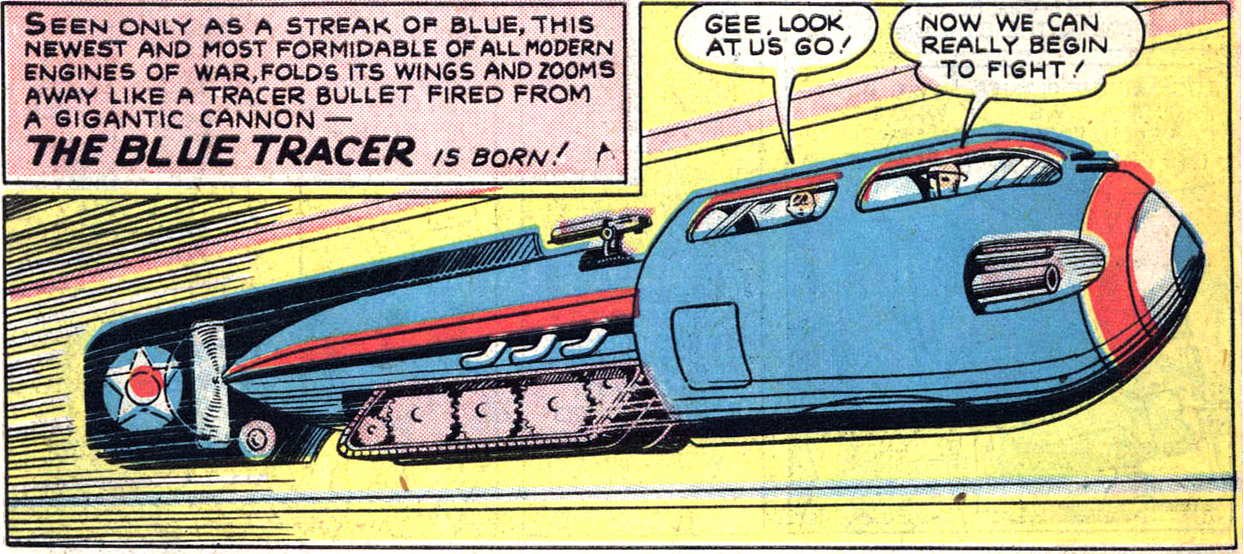
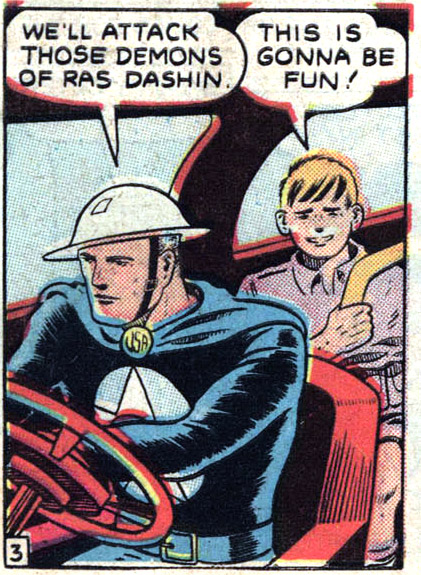
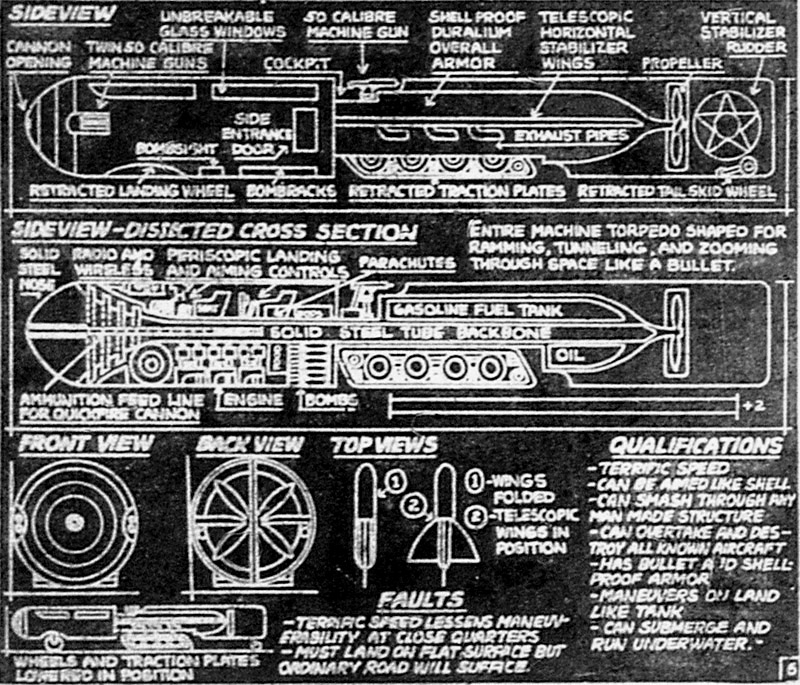
Bill Dunn wasn’t super-powered, but his outfit qualifies him as a costumed hero. Unlike the Red Torpedo, it was never he, but his impervious ship that was called “Blue Tracer.” The Red Torpedo preceded the Blue Tracer in Crack Comics #1 (May 1940). There was also the brief “Swordfish” feature, about a one-man sub piloted by plainclothes Ensign Jack Smith (Hit #22, June 1942). Military #4 depicts a detailed schematic of the vehicle itself. Fred Guardineer was at his best on this feature, crafting utterly stunning scenes of fantastic battle using both real world and fictional war machines.
Captain “Wild” Bill Dunn was an American engineer who was the only survivor of a British “scouting division” in Ethiopia. He soon happened upon Pvt. Boomerang Jones, from Australia, who told him that their enemy was the local tribe called M’Bujies. For months, the two of them toiled to create a war machine from the remains of fascist equipment. This machine was a marvel: the Blue Tracer could travel on land, at sea or in air. Its “hull” resembled a bullet and its chassis included parts from tanks and airplanes. In invading the M’Bujies, they also freed a white woman. (Military #1)
On their next mission, their commander discovered they were alive, which might have earned them court martials for desertion, if not for their good deeds. (#2)
Dunn and Jones traveled the world with the Blue Tracer, fighting Axis threats wherever they appeared. After fighting Japanese in China, (#3) they made a death-defying dive into a Nazi submarine—splitting it in two and emerging unscathed! Dunn then came across the sunken hull of the S.S. Athenia, and pushed it to the surface to terrorize the Nazis into releasing their British prisoners. (#5)
In Russia, they opposed the hook-handed, peg-legged, one-eyed Nazi named Gen. Herman Von Blutt, who managed to capture the Tracer. Just as Bill was about to be hanged, Boomerang saved the day. (#8) And in China, they fought General Muki Zu, the “Yellow Butcher of Koko Nor.” (#9)
After the attack on Pearl Harbor, Dunn returned to defend the home front from the Japanese in the South Pacific. The She-Wolf of the Java Sea was a half-Japanese woman to whom Bill showed films of Japanese brutality in Asia. After the Tracer obliterated a Japanese destroyer, the She-Wolf joined the Allied cause. (#10) More victories against the Japanese followed in Nome, Alaska (#11), and in a face-off against the Tracer’s equal Japanese number—the giant Thing, which was a military robot. Dunn found that the Thing was equally impervious, its Achilles Heel being its human operator. (#12)
The Tracer’s final adventures concerned the Nazi threat. The Nazis developed their own Rocket Tank too, which the Tracer beat by riding it from above into a rock. The local Russians finished it off with Molotov cocktails. (#13) President Roosevelt personally enlisted the Blue Tracer for a mission in the mountains of Yugoslavia. Here the machine demonstrated its most powerful feat to date (and taxed it accordingly) by plunging from the sky and burrowing a tunnel straight through a mountain. (#14)
Dunn had one brush with the super-human when he encountered Nazi soldiers endowed with rapid healing abilities. The power was activated by radio waves and was counteracted by destroying the control tower. (#15) The Blue Tracer presumably kept up the fight throughout the war. Its last mission targeted Germany’s best sub, the U-1. Dunn and Jones were aided by X-6, a double agent working among the Germans. (#16)
Notes
"Boomerang Jones" was the name of another character created by Fred Guardineer, in National's (DC) New Adventure Comics #24 (Feb. 1938). This character was neither Australian nor did he throw actual boomerangs.
The name “Tracer” may have come from the type of ammunition which was developed in World War One, which was designed to be armor-piercing. Indeed, the Blue Tracer resembles a bullet.
The Blue Tracer has never been used by any publisher since Quality’s end (save for a reprint of Military #1 in DC’s line of “Millennium Editions”).
Powers
Dunn was a good fighter and great engineer. The Blue Tracer could travel on land, under the sea, and in the air. It had many weapons, could dive like a shell, and could deflect small arms fire easily. Heavily fortified, it could not be pierced.